

A year of galettes: the strawberry galette of June
Recipe and how-to video for this rustic treat for berry season

“Mmm, something smells heavenly!”
My son enters the house like a tornado, door banging open, then swinging wildly on the hinge, as he’s always traveling at too high a speed to close it. He places his remote controlled plane model on the entryway floor, quite gingerly for someone who nearly took a door off its hinges, then dashes into the kitchen to see what I’m working on.
Today his enthusiasm is rewarded by a warm strawberry galette waiting for him, and he could not have been more eager to dig in.
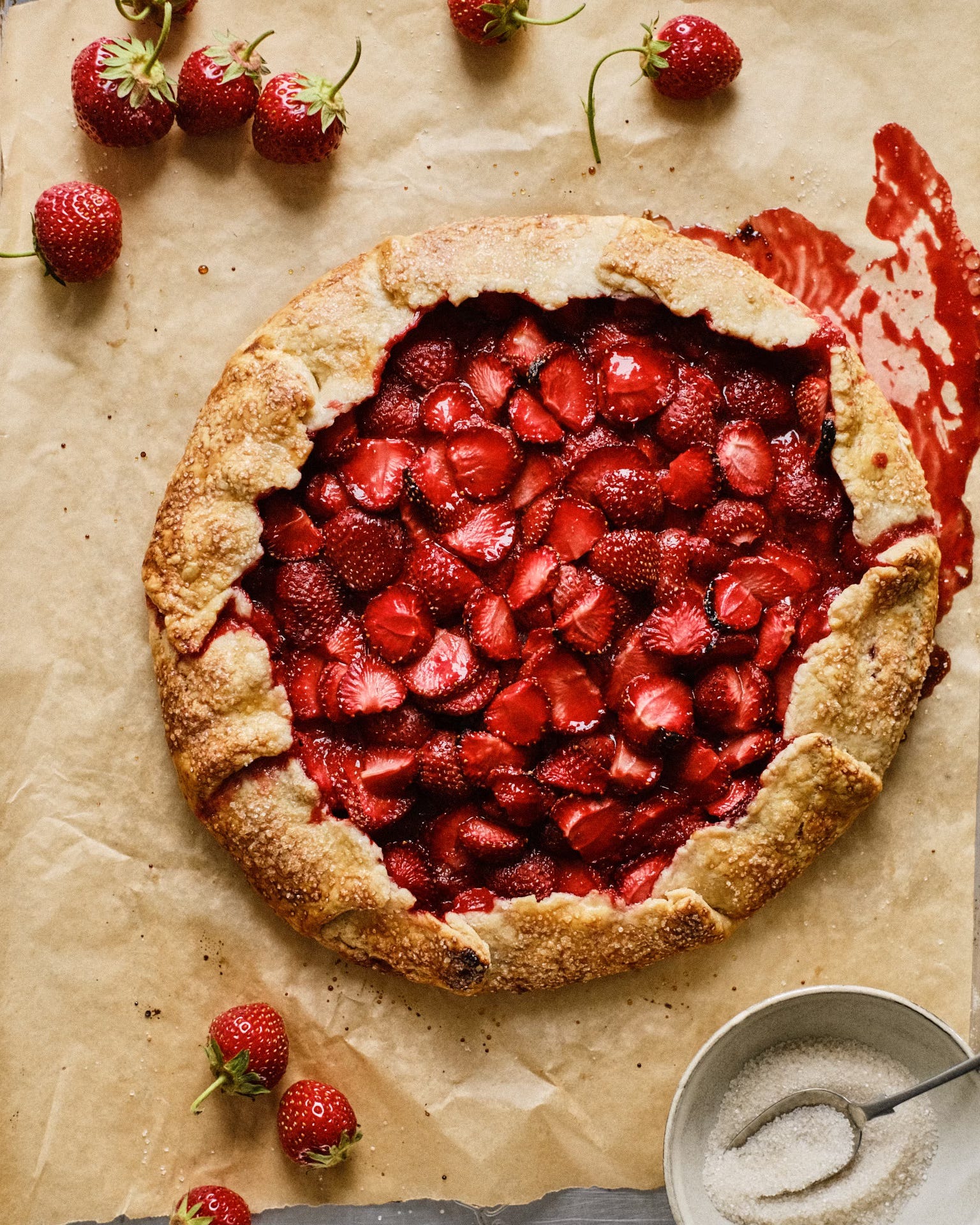
When we left Europe a little over a week ago, we left with the strawberry season, but here at home, in Canada, the season has just begun and we have weeks of abundance ahead of us. The strawberries are plentiful, if a little tart for having had lots of rain but not a lot of hot weather; the blueberries and raspberries and currants will be coming up in a few weeks, and I get quietly excited for all the sweet things I’ll be making.
My pleasures are so mundane. And yet, few things in life, I think, are as good as a slice of warm pie, and I think my son might just agree with me, if he weren’t, just now, more interested in breaking off a large piece of galette crust with his fork, and stuffing it in his mouth.
Recipe notes
A galette is just a rustic, freeform tart or single-crust pie, and once you become adept at making and rolling out the crust, your baking repertoire has just increased considerably. That’s because you can fill this lovely crust with different fruits, creating iterations for any season: plums or peaches in the summer, apples and pears in the fall, nuts in winter, and rhubarb in the spring.
You already might know that I love spelt flour from my scone recipe post, where I wrote about it at some length. It feels like pastry flour in the hands, but is much less processed and better tasting, and coming from an ancient grain rather than modern wheat. Not that I don’t use regular wheat flour in my kitchen, too (this sourdough bread is a favourite). But I always think about how I can promote biodiversity, and advocating for ancient grains and flours milled from them is my way of supporting that.
With that, some helpful notes:
I filmed a video of how I add the butter and work it into the flour (scroll down a bit to watch). It might look and sound like an unorthodox way to make pastry, but I learned it in culinary school from chef Klaus Mueller, and it is the easiest and fastest way to create a flaky crust. He made wicked good tarts, and so will you. TRUST.
the butter needs to be fridge-cold, meaning you take it out of the fridge right before measuring and adding it to your flour.
the recipe works with the same quantity of vegan butter, if you prefer, however, do not use the kind that comes in tubs, but the one(s) that come as sticks or blocks (I’ve tried this and this before, both with good results).
the galette assembly goes like this: you roll out the pastry, spread it with an almond frangipane, and then dollop the fruit on top of that. The role of the frangipane is to absorb some of the moisture in the fruit, as strawberries are particularly juicy. But don’t worry if your galette springs a leak - I like to think all good galettes do, and this is not a problem. Just make sure you’ve lined your baking sheet with parchment, so you don’t have to scrape the sticky juice off your baking sheet.
for my European readers: the normal, all purpose flour in Europe has less protein than my normal all purpose Canadian flour. As such, you can substitute an equal weight of normal all-purpose European flour for the spelt flour in this recipe, so 165 grams. But I had an easy time finding white spelt flour at well-stocked grocers, so I hope you give it a try as well.
I use an organic golden sugar which is less refined than white sugar. You can use whichever, they work the same way.
Here is the video, a little over 4 minutes long with the crucial steps shown. Next time I’ll film in horizontal orientation, I promise.
Strawberry spelt galette
Ingredients:
For the crust:
165 g white spelt flour or pastry flour* (see Recipe notes for substitutions)
⅓ teaspoon fine sea salt or fleur de sel
90 g (scant ½ cup) unsalted butter, fridge-cold
3-4 tablespoons icy water
For the galette filling:
75 g (¾ cup) almond flour
1 egg, beaten, for the almond frangipane
45 g (3 tablespoons) soft unsalted butter
½ cup organic golden sugar, divided
4 cups fresh strawberries, rinsed, then hulled
1 tablespoon tapioca flour or cornstarch
1 teaspoon vanilla paste or extract
1 teaspoon lemon zest, optional but recommended
1 egg, beaten, for the eggwash
Method:
In a large bowl, sift the spelt flour, then add the salt and stir it in with a fork. Using the large holes of a box grater, grate the butter into the flour. As you grate, keep rolling the block of butter in the flour to make it easier to hold onto. When all the butter has been grated, lightly mix it into the flour, rubbing it in briefly with the heel of your hand.
Make a well in the centre of your flour and butter mixture, and add in the 3-4 tablespoons icy water. With the fork, start building the dough, bringing in more flour from the sides and mixing it into the middle, until you obtain a very shaggy ball of dough. If the mixture looks very dry, add another tablespoon of water.
Turn the shaggy dough onto a lightly floured counter or marble pastry board, and bring it together, pressing it together. Knead it very briefly - two or three times should do it. Flatten into a 1-inch thick disk, and return it to your bowl. Cover and refrigerate for at least 30 minutes, up to overnight.
When you’re ready to bake the galette, preheat the oven to 400 F (200 C), and line a large (half-sheet) rimmed baking sheet with parchment paper.
For the almond frangipane, in a medium bowl, mix the almond flour with roughly half of the sugar (we’ll mix the rest with the strawberries), the beaten egg and the softened butter. Keep mixing to obtain a homogenous, spreadable paste. Set aside.
In a large bowl, cut the strawberries into halves if small, quarters if large. To the strawberries, add the remaining amount of sugar, the tapioca flour and flavourings: vanilla paste or extract, and lemon zest, if using. Stir gently to coat all the berries, then set aside.
On a floured counter of marble pastry board, roll out your pastry to a rough 12-inch circle. You needn’t be too precious, it’s meant to be rustic. When ready, the pastry should be about ¼ inch thick. Roll it up onto your rolling pin, then transfer it to your parchment-lined baking sheet.
With a small offset spatula, spread the almond frangipane onto the pastry, leaving a 2-inch border all around. Mound the strawberries onto the frangipane, then fold the pastry border over the filling in the centre, pleating it as you go.
This step is optional: brush the pastry with the beaten egg, then sprinkle with some extra golden sugar, for a bit of crunch.
Bake the galette at 400 F for 32-40 minutes, or until golden brown and the filling is bubbling up in places. Don’t be too concerned if it springs a leak, strawberries contain a lot of water and some of it inevitably collects in the pan. When baked, remove the baking sheet from the oven and place it on a cooling rack. Enjoy the galette when slightly warm, as is, or with a scoop of good quality vanilla ice cream.
Recipe notes:
*If you don’t have spelt flour and/or prefer to use regular wheat flour, you can substitute either the same amount of pastry flour, OR 150 g of all purpose flour.
If you have any questions for me, leave them in the comments. And if you’re looking for more baking inspiration on my page, I’ve linked below to two other recipes for you to try. The clafoutis works beautifully with strawberries, and if you make the oat crêpes, fill them with almond butter and chopped strawberries - they’re a treat!
Until next time!
A French-inspired dessert, for the rhubarb lover

Last week, I fell into a word research rabbit hole. I was trying to find a good enough word to describe the shockingly bold colour of the rhubarb I found at the store last week. First, I searched alternatives for the word “pink” and that sent me next into looking at the word “
Oat crêpes, and timid spring

Ahh, February in Canada. By now, even the most hardy of my Canada-born friends have had enough of snow, and the biting -15°C highs we had last week. At every house’s curb, there are still towering piles of “the white stuff” as we call it, vestiges of the shovelling marathons we all completed in
Music credits: Music by: https://www.bensound.com, License code: J5MW7BAT8GVFODC6, artist: Yunior Arronte